

Higher Esters Dept.
24products.
[Close all]
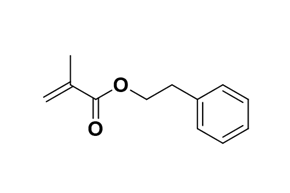
Methacrylic Ester PE (PEMA) is a monomer that exhibits flexibility and a high refractive index within our methacrylate product range. It allows for adjustment of optical properties.
- High refractive index
- Lower Tg than Methacrylic Ester BZ (BZMA)
Prototype
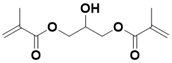
Methacrylic Ester GD (GDMA) is a highly reactive, crosslinkable monomer containing hydroxyl groups. It can crosslink not only with radical crosslinkable compounds but also with isocyanates, epoxy, acid anhydrides, etc. Furthermore, it can also be used to impart hydrophilicity.
Methacrylic Esters
[Close all]
Using methyl methacrylate or methacrylic acid as the raw material, we produce a range of methacrylic esters with diverse characteristics, suitable for many different applications.
These substances have been selected as the raw material for acrylic paint that excellent weather and chemical resistance. We can accept custom orders based on design requirements such as hard materials, soft materials, hydrophilicity, hydrophobicity, and reactivity to provide products usable in many different applications.
Ethyl methacrylate (EMA), Methacrylic Ester E
[Close all]
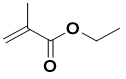
Methacrylic Ester E (EMA) has properties similar to methyl methacrylate (MMA), and allows for fine-tuning of water resistance and flexibility. Methacrylic Ester E is also a highly biocompatible monomer.
- Slightly more hydrophobic than MMA
- High Tg (slightly lower than MMA)
n-Butyl methacrylate (BMA), Methacrylic Ester B
[Close all]
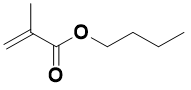
Methacrylic Ester B (BMA) is one of the representative low Tg methacrylate monomers, and is used to impart water resistance, flexibility, and elasticity to resins.
- Higher hydrophobicity than methyl methacrylate (MMA)
- Low Tg
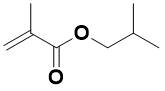
Methacrylic Ester IB (IBMA) is a monomer that exhibits hydrophobicity equivalent to Methacrylic Ester B (BMA) but with a moderate Tg, allowing for fine-tuning of rigidity. It is also expected to improve weather resistance and reduce residue during sintering.
- High hydrophobicity comparable to BMA
- Higher Tg than BMA
- Higher oxidation resistance than BMA
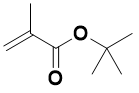
Methacrylic Ester TB (TBMA) is a monomer that combines high hydrophobicity and a high Tg. Compared to using methyl methacrylate (MMA) when forming a polymer, it not only improves solubility in mild solvent but also imparts low viscosity. Improved weather resistance can also be expected.
- Higher hydrophobicity than MMA
- High Tg comparable to MMA
- Higher oxidation resistance than MMA
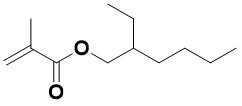
Methacrylic Ester EH (EHMA) is a monomer that can impart higher hydrophobicity and greater flexibility than Methacrylic Ester B (BMA).
- Higher hydrophobicity than BMA
- Lower Tg than BMA
Lauryl methacrylate (LMA), Methacrylic Ester L
[Close all]
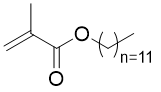
Methacrylic Ester L (LMA) is a monomer that is significantly more hydrophobic and flexible than Methacrylic Ester B (BMA).
- Significantly higher hydrophobicity than BMA
- Extremely lower Tg than BMA
Alkyl methacrylate (SLMA), Methacrylic Ester SL
[Close all]
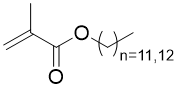
Methacrylic Ester SL (SLMA) is a monomer that is significantly more hydrophobic and flexible than Methacrylic Ester B (BMA).
- Significantly higher hydrophobicity than BMA
- Extremely lower Tg than BMA
Benzyl methacrylate (BZMA), Methacrylic Ester BZ
[Close all]
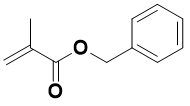
Methacrylic Ester BZ (BZMA) is a monomer with the highest refractive index within our methacrylate product range. It allows for adjustment of optical properties.
- High refractive index
- Medium Tg
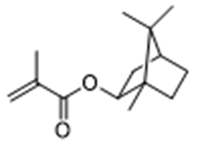
Methacrylic Ester IBX (IBXMA, IBOMA) is a monomer with a particularly high Tg within our methacrylate product range. It achieves both high hydrophobicity and a high Tg. It also has a relatively high refractive index and is used for adjusting optical properties.
- Higher hydrophobicity than MMA
- High Tg comparable to MMA
- High refractive index
Glycidyl methacrylate (GMA), Methacrylic Ester G
[Close all]
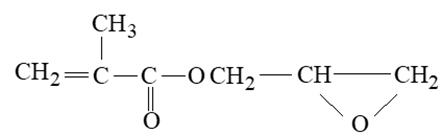
Methacrylic Ester G (GMA) is a monomer that has a reactive epoxy group and is more hydrophilic than MMA. It can be crosslinked with reactive groups such as carboxylic acids and amines to enable highly versatile polymer designs.
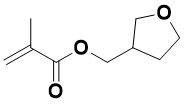
Methacrylic Ester THF (THFMA) is a monomer with a high Tg within our ether monomers product range.
- Hydrophilic and non-crosslinking
- Higher Tg than Methacrylic Ester MT (MTMA, MEMA)
Allyl methacrylate (AMA), Methacrylic Ester A
[Close all]
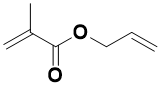
Methacrylic Ester A (AMA) is a monomer containing both a methacrylate group and an allyl group. Because of the difference in their reactivity, it can be used for gradual crosslinking and graft polymerization, which are difficult with dimethacrylates.
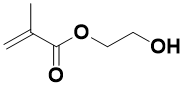
Methacrylic Ester HO (HEMA) is one of the representative hydroxyl group-containing monomers. It is expected to impart hydrophilicity and improve adhesion to metals, glass, and polar plastics. It can be crosslinked with isocyanates, epoxy, acid anhydrides, etc.
- High hydrophilicity
- Crosslinking properties
_structure.png)
Methacrylic Ester HISS (HISS) is a highly purified form of Methacylic Ester HO (HEMA).
- High hydrophilicity
- Crosslinking properties
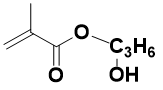
Methacrylic Ester HP (HPMA) is a monomer that exhibits milder crosslinking reactivity compared to Methacrylic Ester HO (HEMA). Its hydrophilicity is also suppressed, allowing for reduced water absorption while still providing crosslinking properties.
- High hydrophilic, slightly milder than HEMA
- Mild crosslinking properties
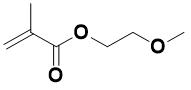
Methacrylic Ester THF (THFMA) is a monomer with a high Tg within our ether monomers product range.
- Hydrophilic and non-crosslinking
- Higher Tg than Methacrylic Ester MT (MTMA, MEMA)
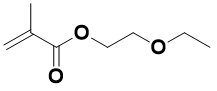
Methacrylic Ester ET (ETMA, EEMA) is a monomer that can impart greater flexibility than Methacrylic Ester MT (MEMA, MEMA).
- Hydrophilic and non-crosslinking
- Low Tg
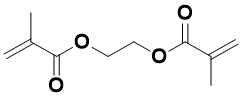
Methacrylic Ester ED (EDMA, EGDMA) is one of the representative crosslinking monomers. It has two methacryloyl groups and forms strong crosslinks through radical polymerization even in small amounts. It is expected to improve strength, heat resistance, and chemical resistance.
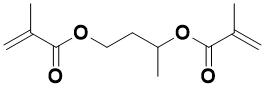
Methacrylic Ester BD (1,3-BDMA) is a monomer with a longer crosslinking distance than Methacrylic Ester ED (EDMA, EGDMA). It allows for adjustment of flexibility and is expected to improve impact resistance.
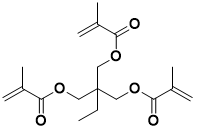
Methacrylic Ester TMP (TMPMA) is a monomer with three methacryloyl groups. Compared to Dimethacrylate such as Methacrylic Ester ED (EDMA, EDGMA), it allows for the design of polymers that are harder and more heat-resistant.
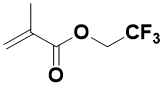
Methacrylic Ester 3FE (3FEMA) is a monomer that exhibits a low refractive index within our methacrylate product range. It is expected to impart water-repellent and oil-repellent properties.
- Product Finder
-